


The Vanished Diamond
Jules Verne
I believe that any future we can imagine can be realized. This science fiction novel was written in 1884, 140 years ago, yet, amazingly, it almost exactly predicts what is currently known scientifically.
The story is about a French engineer who goes on an investigation in Africa and gets caught up in various incidents related to diamond mining. It includes many episodes about the chemical and physical properties of diamonds, such as how they vanish if burned or how the way they sparkle changes depending on the cut. The story itself is fun, with romance and adventure, and scientific information is woven into the characters' conversations. Please read it and enjoy.
Creating new materials that no one has ever touched using high-pressure synthesis
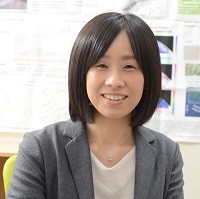
Design, Synthesize, and Characterize Materials
My doctoral research was on high-temperature superconductors, which had just been discovered at the time. As my career progressed, my interests broadened to include complex metal oxides with unique properties, such as magnetic materials, thermoelectric materials, semiconductors, and dielectrics.
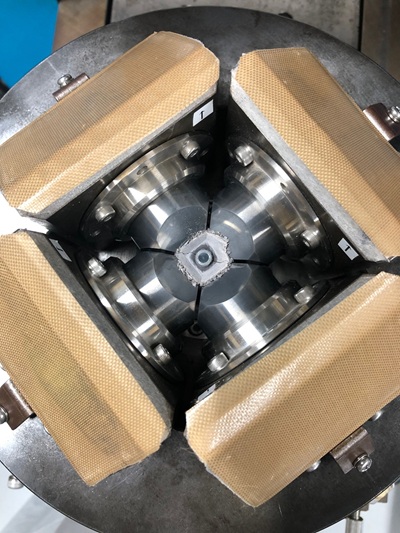
What I truly want to achieve is the creation of novel materials that no one has ever obtained before. To accomplish this, I use the technique of high-pressure synthesis, which involves heating materials under immense pressure—up to tens of thousands of atmospheres.
My work is a continuous cycle of looking at the periodic table, designing a material to exhibit a target function by determining the optimal elemental combinations, then synthesizing and characterizing it. The joy that comes from successfully creating a new material for the very first time is truly exceptional.
Developing Highly Sensitive Thermistors
The current project, "Material Development of Metal Oxide Thermistors by High-Entropy Effect using High-Pressure Synthesis," began when a French research colleague introduced me to high-entropy compounds.
While high-entropy materials originated in the field of alloys, they are now being applied to many ceramic systems, leading to the emergence of unprecedented, unique functionalities.
I focused specifically on the spinel-structured NTC (Negative Temperature Coefficient) thermistor. NTC thermistors are essential components in many home appliances and PCs, where they function by decreasing electrical resistance as temperature rises, enabling precise temperature sensing to prevent overheating.
Conventionally, these devices are primarily based on the material NiMn2O4. In our approach, we equally mixed metals like Mg, Co, and Zn into the Ni site of this compound. As a result, we successfully developed a highly sensitive thermistor that operates effectively at unusually high temperatures, ranging from 300 to 400∘C.

◆学んだことはどう生きる?
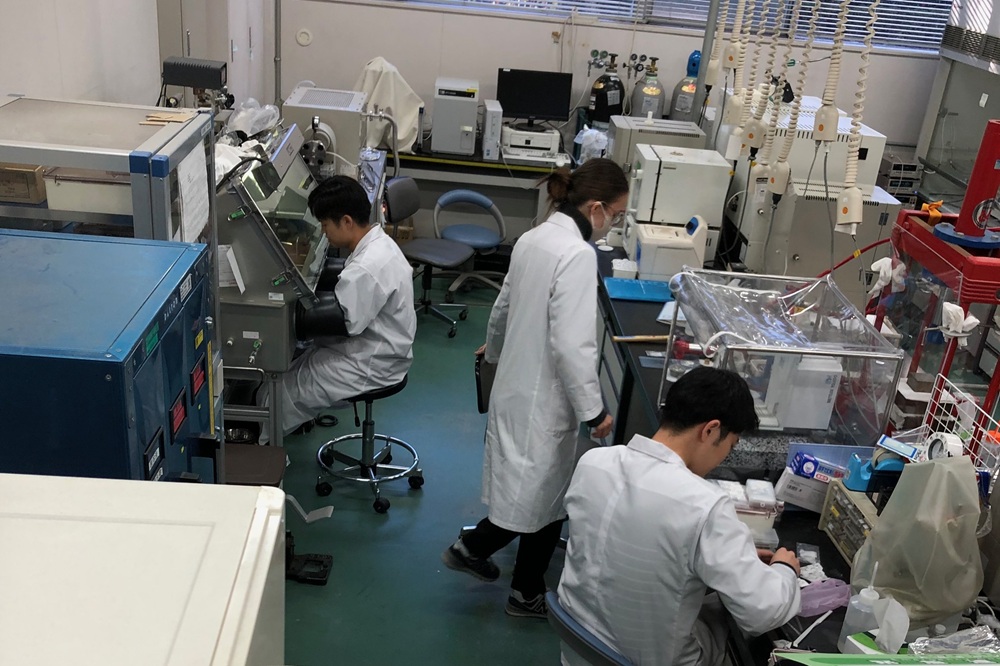
The main research themes for undergraduate and master's degrees are often research on ceramic solid-state reaction synthesis and its functional properties. While not many students work on the exact same theme, companies have a very high desire to hire students who have mastered the fundamentals of materials and research. Students generally find employment in companies they choose, from global corporations to niche excellent companies, in roles like research and development, and quality control.
◆Main Industries:
(1) Ceramics, Glass, Carbon
(2) Semiconductors, Electronic Components, Devices
◆Main Occupations:
(1) Basic/Applied Research, Advanced Development
(2) Quality Control, Evaluation
The Innovative Global Program (equivalent to a department in general) I belong to conducts classes in English, and students start research on a chosen theme from their first year of undergraduate studies. A new aspect is that students don't just "study basic subjects for now" as in traditional universities, but they study because they recognize it as necessary to advance their individual interests and research.
However, because all-English classes can be a high hurdle, students can also study the basics in Japanese and then start their graduation research under a professor in the Innovative Global Program from the third year. A new initiative at my university is that students can enter any of the nine programs in the Faculty of Engineering and then study in a different program later.
Think about the mechanisms of the various thermometers used at home or school. The measurement principle, materials, and price differ depending on the purpose. Many temperature sensors are also built into home appliances, so research where and how they detect temperature.
Buying various thermometers at a 100yen shop and taking them apart within safe limits can be a starting point for understanding the principle.
Wind, Sand and Stars
Antoine de Saint-Exupéry
It offers many insights into the meaning of human life as it exists within nature.
 |
Q1.感動した/印象に残っている映画は? Q1. What is a moving/memorable movie? |
 |
Q2.研究以外で、今一番楽しいこと、興味を持ってしていることは? Q2. Besides research, what is the most fun thing you are doing or interested in right now? |
 |
Q3.好きな言葉は? Q3. What is your favorite quote? |